Institutional literacy
Students and participants in institution-led mental-health learning. Access is by roster or learning-plan assignment. Completion records educational progress — not clinical privilege.
VieroMind Academy
A concise orientation to what Academy is, who it serves, what exists today, and where advisor perspective would be most valuable.
What Academy is, what exists today, and where things currently stand.
VieroMind Academy is a governed learning platform for structured mental-health education, professional development, institutional delivery, and faculty-supported learning. Today it includes four participant pathways, ten practitioner modules, institutional literacy programmes, Faculty and Institution workspaces, and completion records.
Some programmes are still being strengthened and are not yet visible to learners. Specialist review of the practitioner curriculum has not yet started.
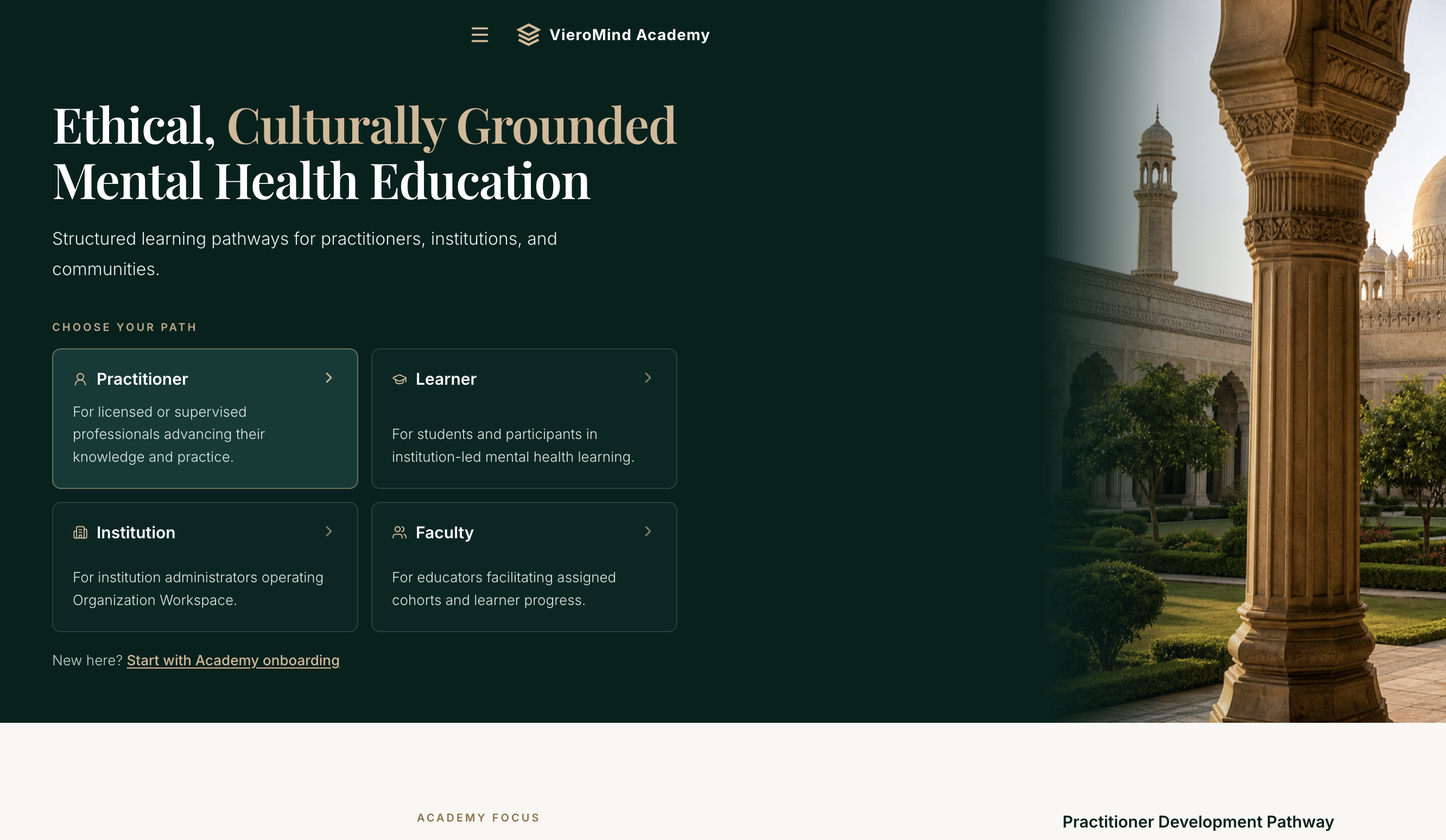
Who Academy is for, and what each path actually means.
Students and participants in institution-led mental-health learning. Access is by roster or learning-plan assignment. Completion records educational progress — not clinical privilege.
Facilitators who oversee assigned learners and cohort progress. Faculty is a separate, independent role — it does not create Practitioner access or clinical supervision authority.
Administrators who run pilots, manage cohorts and rosters, and configure local resources. Partners manage delivery. VieroMind retains curriculum identity, content release, and certificate meaning.
Qualified mental-health professionals in a structured learning pathway. Eligibility is verified under the relevant jurisdiction and institutional requirements. Completion does not create clinical privileges or diagnosis/treatment authority.
Beyond these four paths: Clinical Reviewer work happens only through the Reviewer Console on a formal, separate assignment. That is not part of this advisor guide.
What exists today, what is still in progress, and what a learner or practitioner would actually experience.
Each module includes lessons, assessments, and structured resources. Specialist review has not yet started, and no module is approved for release.
When specialist review begins, it will be conducted by assigned experts — for example licensed clinical practitioners, cultural psychiatry specialists, privacy counsel, or outcomes measurement professionals, depending on the module. Practitioner tools and resources are not available for use until that review completes.
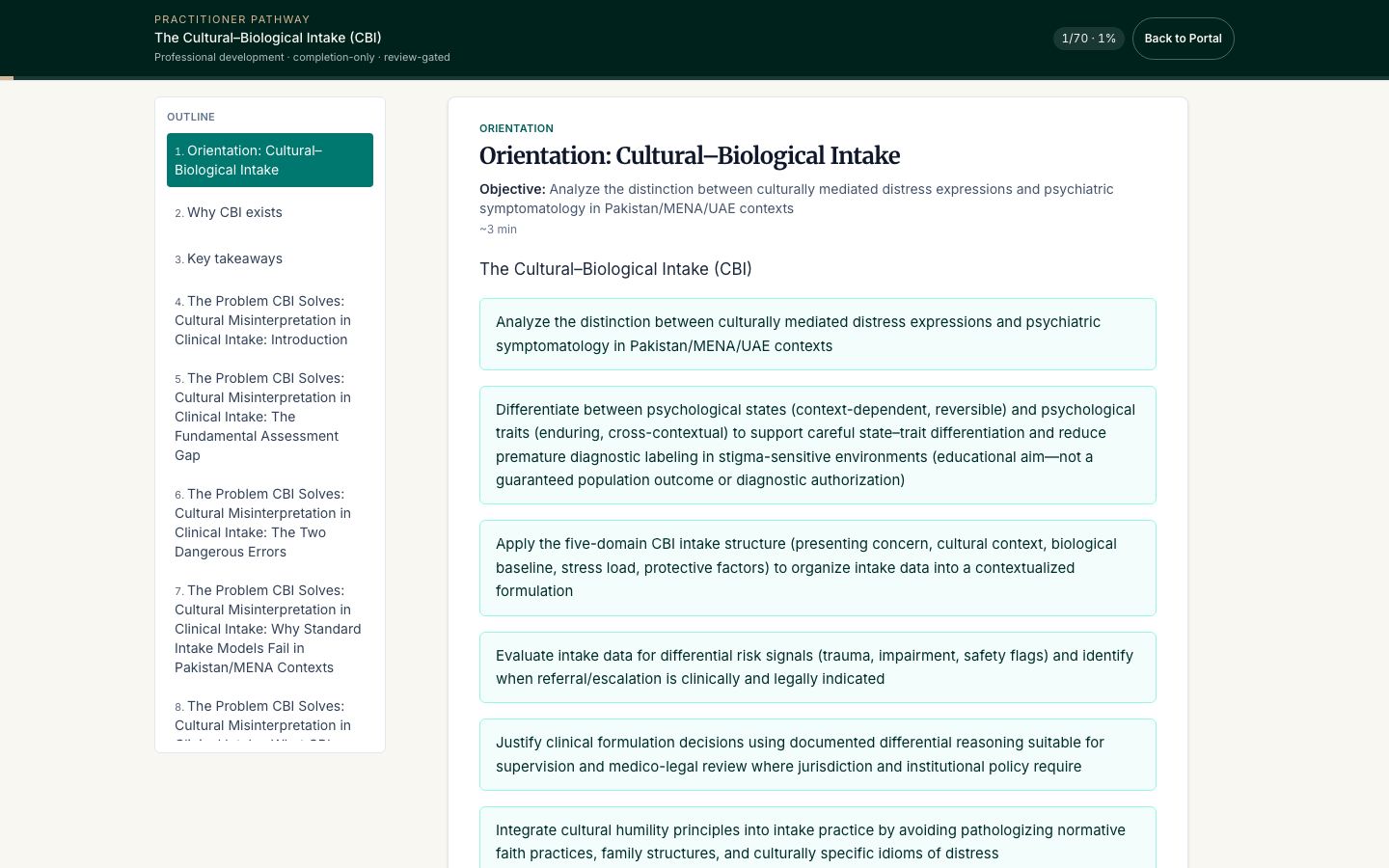
Does the practitioner content reflect Pakistan / MENA contexts accurately — culture vs religion, family and community dynamics, marginalized populations?
Two programmes are visible in the learner catalog today. The rest are prepared, withheld, or held pending further development or specialist review.
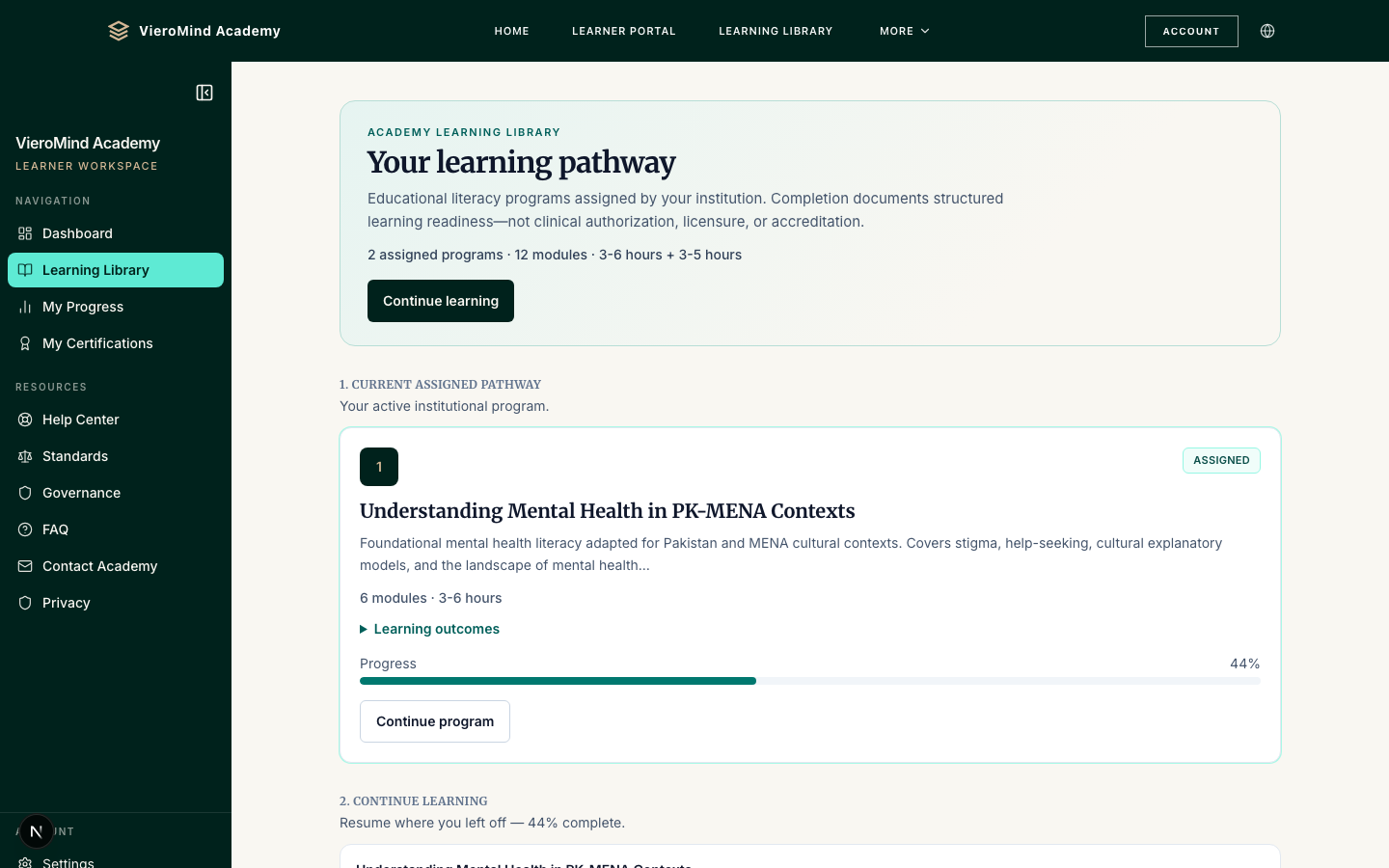
Programme name: Understanding Mental Health in PK-MENA Contexts (sometimes abbreviated UMH).
Who it's for: Adult institutional staff, faculty advisors, student-affairs personnel, peer leaders, and co-curricular adult learners. This is not a clinical pathway.
What it teaches: The mental-health continuum; biopsychosocial context for Pakistan and the region; cultural idioms of distress; multi-level stigma; faith and culture as distinct but related; access and help-seeking.
What it doesn't do: Provide therapy, enable diagnosis, or establish competence as a counselor.
Current state: Core teaching content is available and still expanding. Visible in the learner catalog; not yet complete as a finished educational product.
Where advisor perspective helps most: Rural and remote relevance; stigma, family, gender, access, and help-seeking; whether marginalized populations are represented respectfully.
Who it's for: The same institutional and adult-learner audience as Understanding Mental Health. Completes the learning sequence that begins with that programme.
What it teaches: Public, private, NGO, traditional, and digital care sectors; who does what; where people actually go first; cost, geography, and stigma as barriers; how to connect people to pathways without amateur clinical practice.
What it doesn't do: Provide clinical triage guidance, risk scoring, or hospitalization decision-making.
Current state: Core teaching content is available and still expanding. Visible in the learner catalog; not yet complete.
Where advisor perspective helps most: BHU and primary-care realism; LHW and community-worker realities; specialist vs non-specialist roles; whether referral guidance stays on the right side of clinical triage.
Rural and remote realities; BHU / LHW / community pathways; accessibility barriers; anything missing from Understanding Mental Health or Systems.
Dedicated Faculty Enablement / train-the-trainer is not yet available.
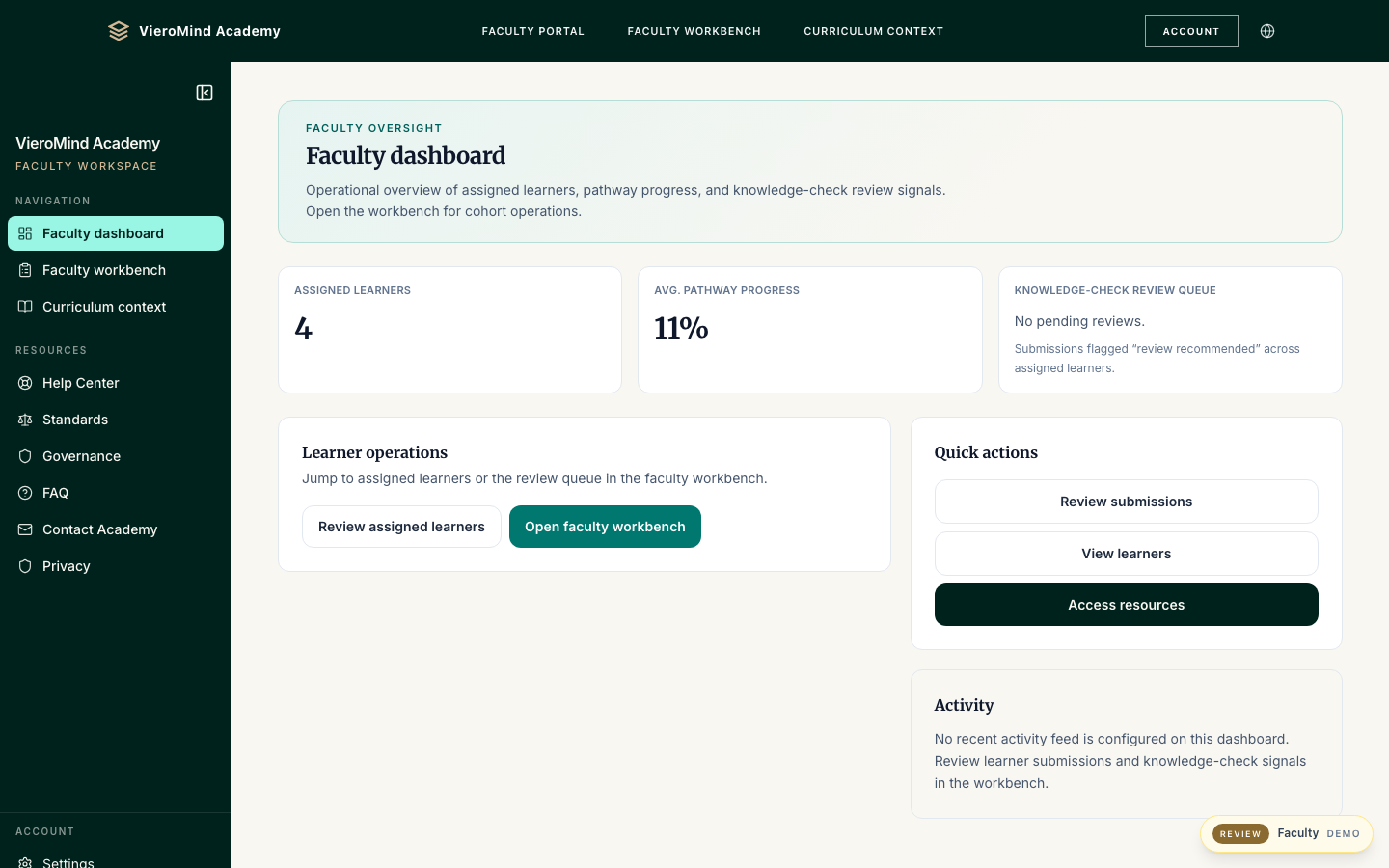
What would university Faculty need in order to facilitate Academy learning responsibly and consistently?
Facilitation needs, reporting, partner expectations, or role clarity for universities using Academy today.
What controls exist today, and what the limits of Academy completion mean.
Each path requires verified eligibility. There is no single shared login for all roles.
Source: Governance →Practitioner modules include teaching content; specialist review has not yet started. They stay gated until that review is complete. Notes in this guide do not substitute for that process.
Source: Governance →Crisis content, some family and faith material, and high-risk tools remain withheld until review clears them.
Source: Governance →Partner institutions configure delivery. VieroMind retains curriculum content, release decisions, and what certificates mean. Academy is not white-label software.
Source: Terms →Academy learning does not constitute clinical supervision and does not replace a qualified practitioner or supervisor.
Source: Terms →Academy is a learning and governance platform. It is not an AI clinical decision system and does not diagnose, treat, or replace therapist care.
Source: Privacy →Published sources: Terms · Governance · Privacy
VieroMind is continuing to strengthen safeguards against title, certificate, training, and institutional misuse. Mixed-methods impact measurement is later-phase work — not a shipped public capability, and not a clinical-outcome claim.
Certificate and title misuse, scope overreach, ethical limits — including what Academy should explicitly prevent in Pakistan.
Look at the live product if useful. Notes are optional — if you write any, you can email them to VieroMind or download a file to send later.
Note boxes appear next to the topics above. Use them only if helpful — you do not need to fill every field.
Culture vs religion; family and community dynamics; whether examples fit the communities Academy intends to serve.
Jump to curriculum notesFacilitation, reporting, partner expectations, and role clarity for universities using Academy today.
Jump to Faculty notesCertificate and title misuse, clinical overreach, and ethical limits specific to Pakistan.
Jump to safeguard notesRural and remote realities; BHU, LHW, and community pathways. A dedicated community / MHPSS pathway is not a current product.
Jump to access notesPractical value and burden; scalable institutional delivery. Future capabilities should be read as future.
Jump to implementation notesChoose one path. You do not need to do all three.
Writing notes here is optional. If you do, they stay in this browser until you choose one of the actions below. This is strategic advisor input — not the Reviewer Console, and it does not mark modules reviewed or unblock content.
support@vieromindacademy.com with your notes in the draft — you review and send.